Discount Insulin

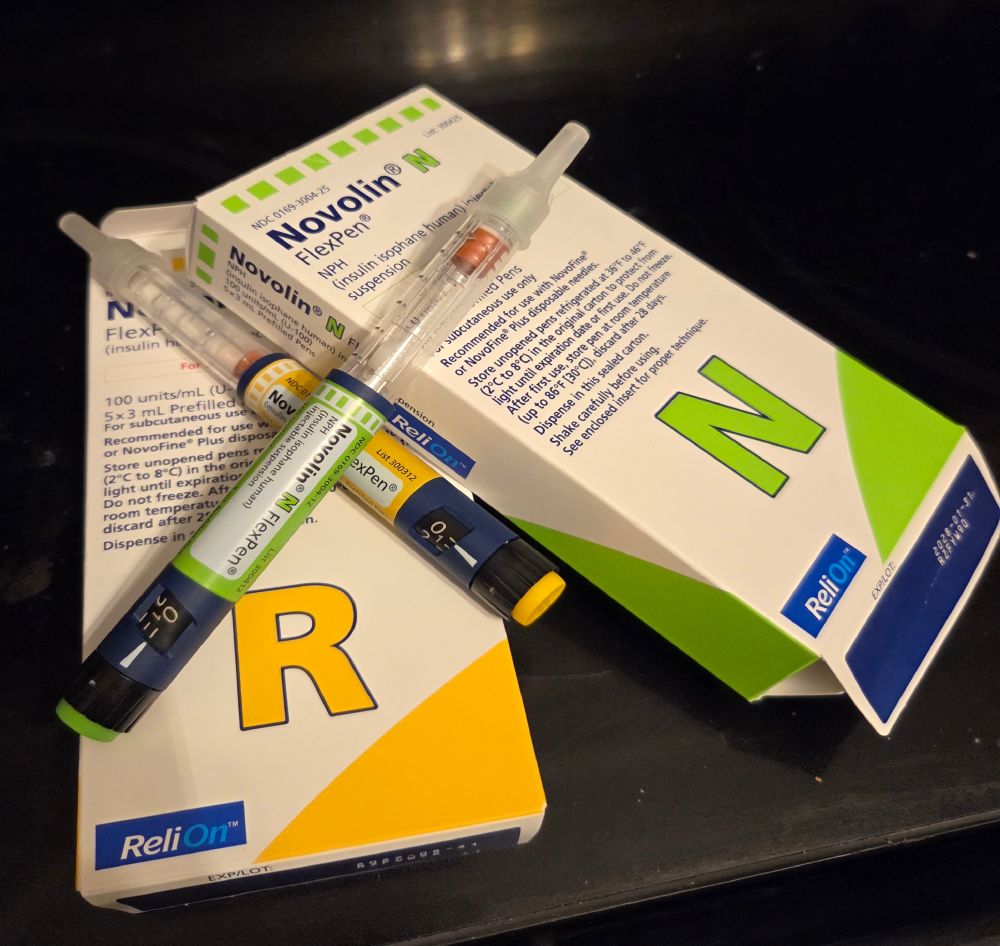
There has been a lot of talk about the discounted insulin from Walmart. Feeling a little rebellious (you get that way after having T1 for over 40 yrs, 24/7, 365), I decided to give it a try. Disclaimer: Those diagnosed with the disease over the past 20 yrs PLEASE CONSULT A DOCTOR BEFORE EVEN ENTERTAINING THE IDEA. It’s different insulin, peaks at different times, and WILL BE more confusing/dangerous than sticking to the formula you are used to. Note: You will need to schedule your time/meals accordingly, you will be on a completely different time table (insulin effects/meals/planning).

Given that I grew up on R(egular) and N(PH), it was a little less of a challenge. And I went solo, because I was getting a little frustrated with insurance and the amount of doctor appointments necessary to keep up. You CANNOT use this medication in a pump, probably will be taking at least 4 injections a day (2R + 2N), possibly less if you choose the 70/30 route. AND, I also stopped using a CGM…testing my levels with blood samples. Totally OLD SCHOOL. (yes, I could have taken it even further with vials/syr)

How did it go?

In the beginning, fairly well. The A1C was consistent with previous results. The major problems arose when I changed my diet from low carb to more countrified home cooked meals. Carbs, carbs, and more carbs. However, these meal changes will affect anyone (on any insulin) negatively if adjustments are not made…which is why you should regulate with a doctor anyways.

Is it doable (to take this insulin regularly)? Well, two of the Walmart pharmacists I spoke with stated that they thought the insulins were more “emergency” products than anything else. Yet, given that I was on this exact stuff for well over a decade, I would say it’s definitely doable. And you can buy it without prescription OR insurance. Is the discount worth the trouble?

The newer insulins are faster acting making them much more efficient. Even without a pump, 24hr/3-4hr insulins provide a more targeted approach to regulating your levels. And a pump/CGM provide (near) real time monitoring with subtle adjustment/corrections throughout the day. It may be challenging/very expensive to get this all set up though. The “accepted” sensors. CGM. Pump. Monitor. And the “accepted” insulins.

What am I doing now? I’m currently pumping again. So far, so good.

Eating Healthy

Typically, budget friendly frozen berry blends are available at your local store. Yes, I’ve been shopping at Walmart lately, so their frozen strawberry, blackberry, raspberry, blueberry combo makes a lot of sense. If you are a fan of Greek yogurt (and budgeting), the store brand makes a lot more sense also. If you are watching carbs, always buy “plain”, unflavored. Why? Because we are going to be adding a TON of natural carbs later.

A buddy of mine suggested tart cherry juice a while ago. Problem is, the sugar/carb content. It is loaded with anti-oxidants and is great for joint health. Use sparingly in mixtures. Stay well under “serving size” on label. It’s very important to buy 100% juice.

So it was a different breakfast this morning. Normally, I don’t mince fresh garlic, throw it in a pot with broccoli, brussel sprouts, green beans..sprinkle with salt and pepper, let cook. But, this morning, I felt like it. Felt like being weird this morning (not exactly an ususual day). Still needed some carbs.

1/2 banana, berry blend mentioned above, 1/4 naval orange, about 1 1/2 tablespoons cherry juice, 2 tablespoons greek yogurt, 1/3 cup 2% milk, 2 tablespoons Bob’s Red Mill Apple Blueberry Granola.

Tossed in the smoothie maker, and had a wonderful breakfast. Definitely not traditional. But with coffee, before and after, felt fantastic. Ready to start the day.

Walmart (+)

Same products, cheaper prices, excellent service. You know what? I rarely, nearly refuse, to promote products or services. But, let me tell you what, Walmart, yes Walmart, is making a very strong case to be a lead competitor against Amazon. If not over take them. The main advantage, brick and mortar stores, facilitating faster shipping and better service (even with groceries and pharmacy).

I did a pickup order the other week, and my car died in the parking lot. Weather, and the fact that my battery hasn’t been changed for quite a few years, probably the culprits. The staff at the store could not have been more helpful. Offering to jump the car (for free), the auto department quick to help out with any future needs which might ensue. A young kid, skipped out to the car with me, couldn’t have been more happy about the weather, and jumped my wagon.

W+, Walmart’s answer to Prime, has been awesome. Grocery delivery for free (within reasonable expectation, usually same day). A shipping option, for free, for non-perishable items, typically same day also. And all this with other perks and a ton of savings.

No shame in this Walmart shopper.

(produce, as far as fresh vegetables, fruit, rice, beans, etc all competively priced also… just a great experience)

Emergency.

It’s around 9:30 pm on a Saturday. I’m sipping a Sam Adam’s Cold Snap (probably my favorite beer). Like a good swath of the country, our area is on the verge of a snow emergency. At this point, I filled the car with gas, boiled eggs, made some cold pasta meals, some rice, beans, and checked the stock of milk and cereal. All good.

The batteries are charged for the flash light, as well as the batteries for the snow blower. Will it make it through several inches of snow on the driveway? Time will tell… and all this gets my mind going. How much profit is created off emergencies? The threat of catastrophe? For products? For behavior? For behaviors that create more profit, from products and services that remove worry and resolve conflict?

Shovels. Food. Seasonal Machinery. Spirituality. Assistance. Products? What is necessary?

After Covid, it seems that several services absolutely took off. Especially the “stay at home” kind. Online medical appointments, grocery pickup and delivery, pharmaceutical deliveries, even car buying on line. Was any of this a direct result of covid? When did the influx of all these damn prescription pill advertisements start on TV? For anxiety. Depression. Cancer. Psychological Disorders. Diabetes?

A marketplace?

The main argument against academia, and the pursuit of higher education is that it creates, then instills, too many questions in students. Are it’s pupils intelligently questioning the status quo and those that rely simply on “faith and confidence” in an existing system? Where does consumerism, marketing and advertisering fit in?

The culture definitely changes with every major event that occurs. Are we, as a society, recognizing this?

Edit: Off the album: This Type of Thinking Could Do Us In!

-SK

If you like this song, this is another great tune by the band. Love music always.

Pump it up!!

So, anyone familiar with Type 1 Diabetes knows that the duration of time (and age of onset) with the disease plays a huge role in outcome/development of complications. Don’t believe me? Do your own research/investigate. Thirty years seems to be a key point when it comes to circulatory issues, kidneys, eye problems, and other challenges related to the disease. Anyone with existing complications is going to spend ALOT more time at different doctors’ offices and face an onslaught of bills.

As I’m nearing 43 years with the disease, I thought I needed to find an insulin pump that works well for me. And I think I found it. Numbers have been in range the majority of the time. No terrifying lows in the middle of the night. No panicking while in the midst of mowing and chomping on a handful of glucose tabs.

The recent A1C was not good. But given the last 4 mo. of stress and uncertainty, it’s forgivable. My doctor is extremely happy with the other blood work and lab tests and thinks the new pump is already doing wonders.

Pretty damn good news.